
Debugging relationships
One of the reasons why high performing organisations continually invest in relationships is that good relationships enable healthy conflict.
Healthy conflict is where we have disagreements, in good faith, about the problem we’re trying to solve and the way to solve it. These kinds of disagreements lead to us being better at our jobs, and doing more effective work (less waste and more value with the same resources). So they are a good thing overall, and people with an appetite to learn, who care about doing a good job, will be happy that they happened.
But!
Interpersonal dynamics are complicated.
Even productive disagreement about technical matters can turn into a drama. One person was feeling a bit off colour one day, and another person interpreted that as rudeness, and now they can’t seem to have a polite conversation about anything. These things happen. They are a normal part of relationships in every part of our lives. (Hello to my husband, if he’s reading this <3).
So if we are an organisation that understands how valuable good relationships are, we need to equip people to debug them when they get bumpy.
Here are three useful tools for that job:
The Third Story
Re-finding common cause is often the first step to take when relationships are stuck.
When two sides simply cannot agree on anything - the one thing they can potentially agree on is that they don’t agree, and that’s a start.
The third story is: “You have your story of the situation, I have mine, and here we both are being human beings - having our own story, and sticking to it”.
2% Truth
Everyone is seeing something. Even when people are absolutely dead wrong, they have come to their point of view because of something real that they have observed. (The earth does look like it’s flat a lot of the time - from which we can learn some things about topology and optics!) The principle of 2% truth is about actively finding the bit of somebody else’s view that you can agree with - no matter how much you disagree with them overall.
The See/Do Cycle
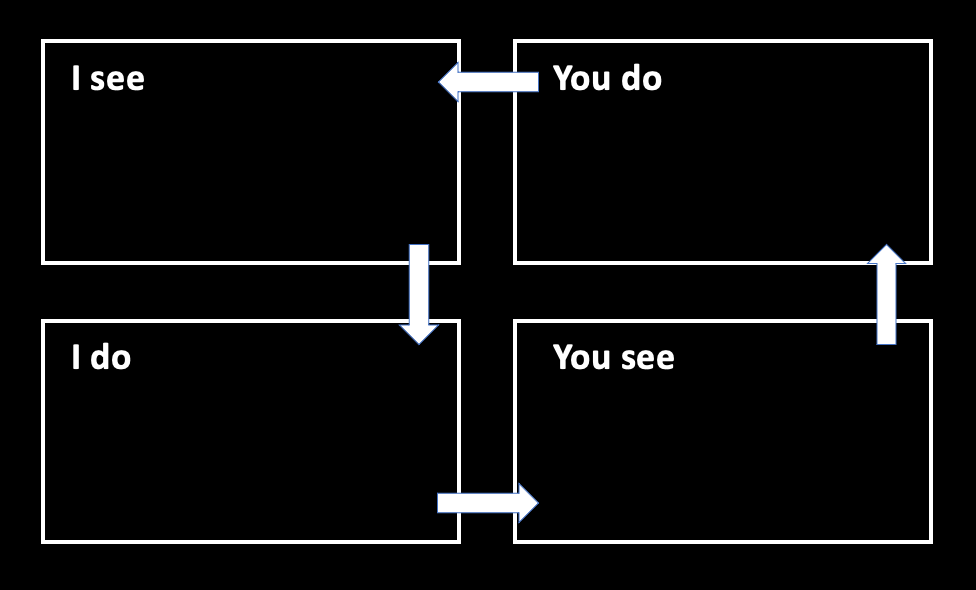
When a relationship gets locked into a conflict dynamic, each party usually thinks it is the other person’s fault: “They are being a jerk!”.
And what do you do when someone acts like a jerk to you? Well, you probably act like a jerk to them. So there’s a cycle that establishes itself where what I see you doing, leads to what I do; and what you see me doing, leads to what you do. And we each go round, reacting to this thing the other person is doing with a behaviour that triggers them to keep doing it. It becomes a very stable, self-sustaining dynamic. Understanding the See/Do cycle is about bringing some more awareness to this so it can get unstuck.
